Showing posts with label grammar. Show all posts

Wednesday, May 25, 2022

Yet another misplaced modifier, this one affecting a cast of MILLIONS.

I have an endless supply of these revision-needed sentences, so I'm going to continue to harangue you. :) 


In longer sentences, you will often have several nouns and several verbs, and some of those will have modifying words, phrases, and clauses. Here's one:

Let's not elect high-level government officials who make decisions for millions who have clear ethical issues. 

Question: WHO HAS THE ETHICAL ISSUES?

The officials, presumably. Or maybe it's "the millions"? 

The verbs don't help. Sometimes the "number" (singular or plural) form of a noun can help us figure it out--

If this were:

Let's not elect A high-level government OFFICIAL who MAKES decisions for millions who HAS clear ethical issues. 

Because "a" and "official" and  "makes" and "has" all mean "one person", we can assume that "has clear ethical issues" refers to the "official". 

We can assume... but the writer shouldn't rely on OUR superior understanding of subject-verb agreement to make sense of the sentence. Better would be:

Let's not elect A high-level government OFFICIAL who HAS clear ethical issues who MAKES decisions for millions.

Now if you read that aloud, you would probably mentally edit that to get rid of the second "who" and maybe the first too--

Let's not elect A high-level government OFFICIAL with clear ethical issues to MAKE decisions for millions.

Here we reduce a clause {"who has clear ethical issues" and "who makes decisions" are both relative clauses with a subject --who-- and a verb) to a phrase ("with" starts a prespositional phrase here, and "to make" starts an infinitive phrase). Reducing the, shall we call it "syntactical complexity", of a modifier usually makes the sentence clearer, as it's more obvious what the main subject/verb unit is (Let's not elect). 

So... back to the original sentence. 

Let's not elect high-level government officials who make decisions for millions who have clear ethical issues. 

The quickest fix is moving the "who have" clause to be adjacent to the word it modifies:

Let's not elect high-level government officials who have clear ethical issues 

Then again we are going to have to go with an infinitive (to make) because now those stacked "whos" don't work--

Let's not elect high-level government officials with clear ethical issues to make decisions for millions.

I'm not pretending this is a great sentence. But it's a grammatical sentence that clearly conveys exactly what the author meant.

Another episode of  read and revise like an editor. :) 


Monday, April 25, 2022

Correctly Placing Misplaced Modifiers

 Alas, I constantly edit, even when I'm not being paid for it, the author didn't ask for it, and I can't actually share it. It's just a compulsion that happens as I read, especially news stories that have presumably already been edited. 

And heck, why not share the compulsion here? Maybe someone will learn from it. I do 'revision sessions' sometimes with students, just editing on-screen and explaining as I go, and this misplaced modifier problem is one of the most common and also one of the most easily fixed mistakes.

In a sentence, a "modifier" is a word or phrase or clause which "modifies" or deepens or narrows the meaning of another part of the sentence. The most common modifiers are the one-word adjectives and adverbs which add to the meaning of a noun or verb, like: The girl's outfit proudly proclaimed her Ukrainian heritage.

But often the modifier can be an entire phrase: 

  • The play took place in the old Gem Theater
  • He was waiting for the bus to come
  • The morning before the party, the dog got sick.

Or the modifier can be an entire clause (with a noun and verb):
  • He didn't notice the shocked silence that fell across the room when he wrote his name on the board.
  • The more you remember, the more you have to forget.
  • --


Some modifiers are "bound"-- that is, they have to be in a particular position, like just before the noun they modify. You know-- The pink dress. (Not --  The dress pink.) These "bound" modifiers are usually single words or short phrases that modify a noun (that is, they are "adjectival," which means "modifies the noun" :). 

Usually, however, modifiers are unbound, especially the phrase and clause ones, and therein lies the problem. An unbound modifier can "legally" be moved around to different parts of the sentence, but what's possible isn't always what you mean. Sometimes being too free-range with modifiers creates the horrific crime of a dangler, where impossible and sometimes painful things happen:

One day she hunted for a moose wearing diamond earrings.

Decisively blocking the knife, her eyes narrowed with purpose.

Ouch.


I have a lot of examples of this kind of mistake, but just for now, let's fix an easy one, adapted from a sentence in a major mag article:

She admitted her enjoyment of the bullying on Facebook last year. 

Many misplaced phrases have to do with time or place-- the "where and when" of the sentence. I see this most often when there are more than one actions in the sentence, as here:

She /admitted /her enjoyment /of the bullying. (Ignore the "on Facebook" and "last year" for a moment so we can focus on the kernel sentence.)

Subject/Verb/direct object/prepositional adjectival phrase.

We usually think of action as being represented by the sentence verb (here, admitted), but actions can also be shown in nouns (participation, bullying). So here there are three actions, all of which took place but perhaps not all at once. 

Actions take place somewhere sometime, and "somewhere sometime" are often important "condition markers" to add to a sentence. (I mean, these words and phrases mark an important condition that changes or specifies something about HOW the action happens.)

But while the position of where/when modifiers might be moveable, the reality isn't: SOMETHING happened last year. SOMETHING happened on Facebook. 

Options:

1. The admission.

She admitted last year...

And/or-

She admitted on Facebook...

2. Her enjoyment.

...  her enjoyment on Facebook...

and/or-

...  her enjoyment last year...

3. The bullying.

...of the bullying on Facebook.

and/or-

...of the bullying last year.


(I know it's not a great sentence because I modified it to protect the guilty. :)

Because the author placed the where/when modifiers at the end of the sentence, right after "bullying", readers will be forced to assume that the bullying took place last year on Facebook. And that might be exactly what happened (although it's not in this case).

But... what if that's not right? What if the bullying took place last year at school, and she enjoyed viewing a video about it last week, and is only admitting it on Facebook?

What happened on Facebook?

What happened last year?

(Some of this info might have been revealed in previous sentences, though not in this case. And still, that's no excuse for imprecision in this sentence. When all it takes is a moment to get it right, make it right. :)

What's a revision which makes those very clear so that the readers won't be confused about what happened when and where?

On Facebook, she admitted her enjoyment of the bullying last year.

or

She admitted on Facebook her enjoyment of the bullying last year.

Sometimes it helps to "bind" a modifier to the modified word so that there's absolutely no question--

She admitted on Facebook her enjoyment of last year's bullying.

==

This is just one sentence and one set of facts, and one point of misplacement. Though I will try, there's no way to identify every possible opportunity for imprecision. 

There are as many options as there are possible permutations of actions and actors and conditions in any sentence. But ONLY ONE IS CORRECT. This isn't about delicate subtext or deliberate ambiguity or debated issues. This is just about placing factual information in the correct place in the sentence. You can get it right as easily as you can get it wrong. But you have to recognize when it's wrong, and then make it right.

Anyhoo, point is: Be sensitive to the meaning you create when you put a modifier somewhere in the sentence. Stop and think about the various interpretations the readers might make of this placement, and whether moving the modifier might make more sense. Time and/or place modifiers are especially tricky.

So if I mean the ADMISSION, not the enjoyment or the bullying, took place on Facebook, I have two easy options (the first being optimal). While we're at it, let's make clear it was the bullying and not the admission that took place last year.

On Facebook, she admitted her enjoyment in the bullying last year.

She admitted on Facebook her enjoyment in last year's bullying.

I have a bunch more examples that I'll post and fix in the future. Usually in order not to shame the writers and editors (who, grumble grumble, should know better), I'll change the words and keep the construction.

This is what passes for giggly gossip in my life. :)

A blast from the past-

The columnist James Kilpatrick used to devote his first column of the year to the many ways you can place and misplace the word "only" as a modifier in a sentence, and used this example to show the difference in meaning:

  1. Only John hit Peter in the nose.
  2. John hit only Peter in the nose.
  3. John hit Peter only in the nose.
  4. John only hit Peter in the nose.

(Wouldn't you say "ON the nose"? I would. I'm not sure how deep I would want to hit IN the nose.)

"Almost" and "already" and "just" are other common modifiers that can be moved almost anywhere, but each placement means something different.


Here is a nice British professor who does a great job of showing how to determine what a modifier modifies and how it works in a sentence. 

You can find some good examples of misplaced modifiers at this Guelph University site. 


Sunday, September 23, 2018

Either/or== Must we choose between proper mechanics and creativity?

I'm asking this because this is a question that comes up a lot: "So someone submits a perfectly clean manuscript, every comma in the right place, but it's boring. And someone submits a manuscript with a lot of grammar mistakes, but it's a great story. Which would you take?"

Hmm. That's a toughie. It's especially tough because in my experience, good creativity and good mechanics are NOT mutually exclusive. Far from it. Language is the way we present our stories, and the presentation is important for getting the story right.

To tell you the truth, I seldom see a "great story with terrible mechanics." (I have seen a few perfect manuscripts with boring stories, a few fairly good stories with terrible mechanics... mostly I've see okay stories with okay mechanics, alas.)

First, I guess I'd like to say-- no editor is looking for a perfect manuscript. Editors assume that there will be a few typos, a few infelicitous phrasings, some small format problems. No editor starts hyperventilating at the prospect of working with a writer who is a little less than perfect on every page. Got to justify existence, don't we? Perfect writers don't need editors!

So never worry that the editor is going to read 200 pages and on page 201 discover that misspelling and decide to reject. That won't happen. But what if there are four misspellings on the first page? What should the editor do then? (When encountering a lot of mechanical problems right away, I started sending back the submission without reading further, and saying, politely I hope, "I know you would like another chance to edit so that this is easier for me to consider." Generally, the writers have all thanked me for the chance, though who knows what they're really thinking. :)

One thing I do have to point out is that there really isn't an either/or here. Creativity might be messy at the creation stage, but I know very well there is no need for a good story to be messy at the submission stage. Most good stories go along with at least adequate mechanics, because the writer cares enough about presentation and narration to work hard at things like sentences and paragraphing. Most good writers don't assume that "story" is just "idea," but understand that ideas are developed in scenes which are made up of causally linked passages which are made up of paragraphs and sentences.

A mechanically inept manuscript is, in my experience, more correlated to inept development of the central idea or plot. I might see, in a mess of a manuscript, a good plot idea, or a glimmer of brilliant characterization. But that's usually all there is-- an idea, a glimmer. The execution and development aren't done well, particularly at the scene level. Why, well, interestingly, I think, there is "story grammar" and "scene syntax." Just as in a sentence or paragraph, stories and scenes have relationships that are shown in the structure or design. If the writer doesn't get that this pair of sentences shows a causal relationship:
He lurched forward, his mouth open.
I got out of the way.
Then probably the same writer isn't going to design a scene developing the cause/effect relationship between bigger events, although those events might be terrific.

Have I ever seen a great story with lousy mechanics? Yes, but mostly with my college students. If they come from a storytelling family or culture, often they get the story grammar talent with mother's milk. They've been surrounded by great stories all their lives. But usually this is oral storytelling, and often their ability to write it down is limited. We see this a whole lot with non-native speakers, especially those who left their home culture before high school, so that they aren't "writingly fluent" in their native language either.
We also see this in native speakers who didn't have adequate educational experiences (or who weren't paying attention... the class clown comes to mind-- usually he's a great storyteller.) The issues are usually spelling and punctuation, not sentences-- that is, it's really the -writing- stuff, the letters and punctuation marks which aren't clear in spoken English that cause the problem. Sometimes word choice is lacking too, especially in non-native speakers-- they just don't yet have the vocabulary. But they do have the ability to describe setting and people, to design scenes for maximum drama, to select the telling detail.

I had two students like this in one semester. They both would have gotten an A if I taught speech. As it was, one got an A, the woman who wrote very affectingly about her grandmother being diagnosed with Alzheimers the same week the writer found out she was pregnant, and how that baby ended up helping the grandmother keep her speech long into the illness. She worked closely with me and a tutor to find the mechanical problems that got in the way of the story presentation.

The other was a young man who wrote (this was a kind of emotionally wrenching semester) about getting to the hospital just a few moments after his mother died, so he couldn't say goodbye. The urgency of the journey across town -- wow. Beautifully structured with great suspense. But he didn't have the time to transform this great story into a great paper, and didn't get as good a grade (though I made sure he knew that he had all the right stuff and just needed to go this additional step, and I hope he did in the future).

So I know it's possible to have great story/bad mechanics-- but I have to point out that these were students in freshman composition, each coming out of an oral tradition that rewarded great story design and impressive vocal performance (which they had-- as I said, they both would have gotten As in a speech class). Transferring that to written language is a separate process.

But if you're submitting a written manuscript to a book publisher, well, it's expected that you are as adept at the tools of the craft. Those students might not know so much about punctuation and other elements of written language, but they did know how to use vocal expression and pauses and body language as they told their story. (They weren't so great at first at transferring that to writing, but they really did have the vocal tools for storytelling.) If you choose to write this story, it's kind of expected that you would use the written-language tools adequately.

Now, as I said, minor errors are not the issue here, and I think writers who get upset when I say I want a mechanically adept manuscript might think I mean no typos. But what I mean is-- well, truth is, most of you would be shocked to see a story with dialogue like this:

He said "Joni Im sorry about your cat's.
She said don't worry about it. There probably hiding in the garage"

That's not actually the sort of "messiness" that goes with creativity and great ideas. But that is what we see a lot. And that sort of leaden presentation means the voice is usually leaden too. Voice isn't just about word choice-- it's developed through sentencing and punctuating too.

So... let's say you are like my students, trained by tradition and upbringing and talent to be a great storyteller but not a great practitioner of the written discourse? You know what I'd suggest you do? I'd suggest you dictate your story into your phone recorder, and hire a good secretary or transcriber to type it. (If anyone knows of a speech-to-text app which does a good job, let me know. My "twalking" -- talk-walking- recordings always end up as gibberish as text.)

Many transcribers have been, uh, quietly editing their clients' prose for years, and know how to turn your dictation into an fairly adequate manuscript. (When I worked at the late lamented Grammar Hotline, most of our callers were secretaries who were interested in getting the grammar right, or in proving to their boss they were right, and they usually were.:) If the problem is getting it from oral language to written language, it's probably easier and cheaper to hire someone to make the transfer yourself.

Now that I think of it, the corollary -- the perfect manuscript and boring story-- happens more often. That's because you can hire someone to turn oral language into written language -- same words, after all, and it will still be YOUR story, not the transcriber's. But if you hire someone to design your scenes, deepen the characterization, create a suspenseful tone, structure the events-- it's not really your story, is it? All those things ARE story. (And that is why people hire ghostwriters, I guess.)

Thinking back on perfectpunctators/lousystorytellers... I have seen that too. I used to write Regency novels, a subgenre that attracted a lot of English teachers and librarians (it's set in the time of Austen, see). And when I'd judge a Regency contest, I'd frequently get an entry that was well-written on the basic word level, but lacking in story grammar. They knew how to write a sentence, but couldn't flesh out a character. They knew how to punctuate dialogue, but not how to make it sound authentic. The story would never be insane (that's much more likely with the messy manuscript, and yeah, I've seen that a lot too), but it would be "by the numbers," often using conventional situations (ballroom scenes, mistaken identity) with nothing fresh added.

In a contest, this would often score sort of on the high end of mediocre, but never win. And really, I don't have a quick solution ("hire someone to type it") here. The problem is more global, more personal-- that is, the writer probably doesn't have a great imagination and/or an innate or learned sense of story grammar, and you just can't hire that. (But I do think these would be great transcribers for the oral storytellers out there! :)

So... which of the two (messy but good story, clean but boring story) would be more likely to be published? Hmm. Well, of course, when we pick up a published book, we're seeing an edited version, not the original submission. So there might be plenty of previously-messy books that have been wrestled into rightness by a pair of editors and a proofreader, and we'll never know unless we get the editor drunk. ("You know that writer of mine who made the NYTimes list last week. Boy, you should have seen the manuscript when it came to me. One long sentence, the whole first chapter. I kid you not. You're buying the next round, right?") Notice that this requires a lot of time and energy from the editors and money commitment from the publisher, so a damn good story is required, not just a good story, to elicit that much effort.

But we certainly all read boring but well-written books. They're well-written enough that we don't take them back to the bookstore and demand our money back, or post nasty reviews on Amazon. We don't feel passionate enough about them for that level of response. Meh... we sort of wonder why this book was chosen out of the many the editor must have read that month. (Probably the original book for that slot didn't come in on time, so they needed a book to fill the gap, a book that didn't require much work to make presentable, and this one landed very cleanly on the desk at just the right moment. See why it's a good idea always to send in a clean manuscript? "Doesn't need much editing" is maybe not the fulsome compliment you were hoping for, but there are times when that's exactly what the publisher wants in a book.)

Well, anyway, we should all strive for great story/great mechanics. Figure out our weakness and what to work on to overcome it, but maintain our strengths too.

I'm remembering a query I got from one of those meticulous types, the one that made me really WANT to buy out of pity-- "I always make deadlines. I always deliver a clean manuscript. I have worked as a proofreader for a decade"-- it was sort of sad. Imagine an epitaph: "She always made her deadlines, including this one."

Alicia
Writing articles

Saturday, September 22, 2018


How to Write a Great Sentence  , The Guardian

Every writer, of school age and older, is in the sentences game. The sentence is our writing commons, the shared ground where all writers walk. A poet writes in sentences, and so does the unsung author who came up with “Items trapped in doors cause delays”. The sentence is the Ur-unit, the core material, the granular element that must be got right or nothing will be right. For James Baldwin, the only goal was “to write a sentence as clean as a bone”.


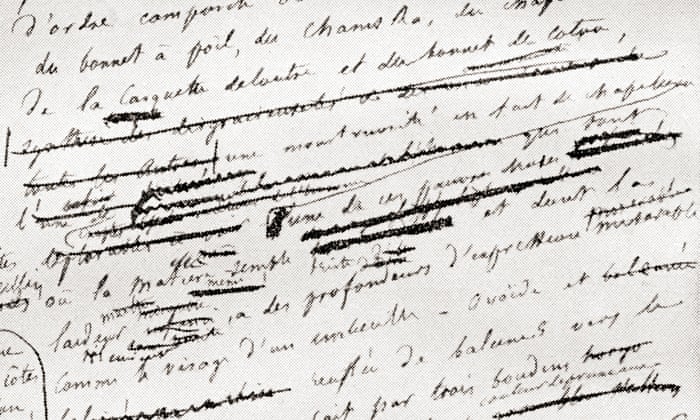
An Edited Page from Flaubert's manuscript for Madame Bovary

Friday, September 15, 2017

The Oxford Comma, Robert Frost, and Comma Suicide


This will start out boring for non-punctuation-lovers, but then I'll quote Robert Frost, which is always a great benefit to society. So slog through the boring part to get to the poetry and my explanation of how Frost shows how important it is to "know the rules, then break them."


Oxford Comma
Here's a minor comma fix, and it's more "discretionary than obligatory:" The Oxford comma.
For some reason, the final comma in a series (before the "and") is called the Oxford comma, but it's also called the "serial comma". The rule is, when you have a series of three or more items in a row, with "and" before the last one, you put a comma before the "and" so that there's a comma after each item. So: The US flag is red, white, and blue.

This is done differently in journalism, where they used to have to save space and ink and so eliminated as many comma rules as they could. J So you'll see the "and" without a comma before in magazine and newspapers and often on news websites too.
Academic writing, however, follows the rules of book publishing, and the "Oxford comma" is the convention there. Just a minor change, and as I said, this is a rule in academic and book writing, so you'll often see series without that comma in the popular press.
More about the "Oxford comma"


What About Robert Frost, You Ask?

The great American poet Robert Frost surely knew the rules. No one made better use of the conventions of the language and grammar than he did in creating his deceptively simple and lovely poems. He's a great example of how understanding the convention (and how the reader would conventionally read something) in order to subvert it for a greater or deeper meaning-- punctuation becomes subtext.

Now as I said above, the general rule followed by book editors and publishers is that when there is a series of three or more like items (like three adjectives), you place a comma before the "and" or the last item in the series, indicating that these are all basically similar and yet separate from each other.

So with Frost's poem in manuscript, the book editor (or, as the Frost myth goes, the typesetter of the book, cleaning up after the editor ) saw this line with this series:
The woods are lovely, dark and deep

Well, of course the punctilious editor/typesetter made haste to add that Oxford comma-- the RULE.
And usually, that would have been exactly correct.

However, again according to myth, Frost saw the proofs and quickly "stetted" or insisted that the original be maintained.

Why? Was Frost being stupid? Did he not know the rule?

He knew the rule. He knew what effect abiding by the rule would create for the reader. And he knew he wanted another effect, one that could be achieved by subverting the rule.

Let's look at the two meanings-- comma in or comma out.

Here's the entire stanza. This is the final verse of that achingly beautiful poem, "Stopping by Woods on a Snowy Evening".  (You can read the whole poem, and you really should, here at the Poetry Foundation.)

The woods are lovely, dark and deep,   
But I have promises to keep,   
And miles to go before I sleep,   
And miles to go before I sleep

So this was what Frost ended up with-- what he started with, what he wanted-- comma out.

Why did he insist on that change, or rather, the change back? The defiance of convention? 


Let's look at the meaning conveyed by each option.  
Comma in:
The woods are lovely, dark, and deep.
With that comma in, the three adjectives are "equal in weight". That is:
The woods are lovely, the woods are dark, and the woods are deep.
They each modify or describe "the woods".

Now take the comma out, and see what happens:
The woods are lovely, dark and deep.
With the comma out, the "dark and deep" now modify "lovely":
The woods are lovely, because they are dark and deep.

See the difference?

The first is a placid and unremarkable (though perfect in its scansion :) description of the woods.

The second is a subtextual confession of the longing for "darkness and depth".

Here is a man who has stopped by a snowy woods on a winter evening, a man weary of his responsibilities, his "promises to keep", and momentarily transfixed by the "loveliness" of the woods. And what is lovely about them to him? The darkness and depth. The death. (This is poetry, so it won't be transparent. This is Frost, so we must always search beneath the extraordinary "prettiness" of his prose to find the deep meaning he always embeds.)

He looks at the woods. He finds the darkness and depth "lovely". He thinks of... well. No. He can't do that. He has promises to keep, and miles to go before he sleeps.

We have just witnessed a man choosing life. 

Those final lines (repeated just to make you ponder this):
But I have promises to keep,   
And miles to go before I sleep,   
And miles to go before I sleep

Those would have little resonance if all that had just happened was the man stopped and saw the pretty woods and commented on how they are "lovely, dark, and deep."

Coming after that line with the missing comma, however?

They mean he's made a choice. He will not succumb to the "lovely dark and depth." He will keep those promises and trudge those miles and then sink into a temporary (not permanent) sleep.

He knew the rules. He chose to break them-- for a very specific effect. That effect could happen only if he could trust that most readers would know how it "should" be punctuated, and stop and wonder why the comma was left out.

This is one of the great techniques we have when we craft and refine our own voice. We can know the conventional rules and the conventional and usually appropriate effects they will have.
And then we can choose to subvert the rules to achieve a different effect. 
It's not just breaking the rules to be defiant or because we're ignorant... but accepting the rules, knowing that they create a conventional meaning, knowing that now the reader-- trained in the conventions-- will be surprised and thoughtful in discovering this new meaning.


We are in control of our own voice. But we need to take control. We need to know more about the language and how it can be manipulated-- and most important, we need to know how the reader will interpret our choices.

Well, heck, time to go read that whole poem. I encountered this first in 5th grade at St. Aidan's School in Boston. Interestingly, the nun (nuns weren't known then for cross-curricular pedagogical innovations) Sister Hugh had us put this poem to music, and I could still sing our ballad if you want. (You don't.) I thought it was the most beautiful poem in the world then. (I'm still pretty in love with it.)


Friday, May 19, 2017

Grammar questions answered: Restrictive and non-restrictive

I asked for some grammar questions, expecting/wanting some softballs. Ha! Not a chance. But I will throw myself to the wolves and try to answer.

Stacey asked-
Here's my question(s): What is a restrictive clause? What does it mean, really? What makes it restrictive?

I ask this, because I have a note that says if I'm using the word "which" in a restrictive clause, I should replace it with "that." It would be a helpful note if I knew what it meant! Hahaha! :)

 Okay, to get very basic, a clause is an element which has a subject and verb, and it can be "independent" (can be a sentence on its own, like This will be a long and tedious explanation), or dependent, (which can't be a complete sentence on its own, like which will be hard to understand). 
 Dependent clauses can be used in many ways in a sentence, like to establish some time or place condition--
When I was young, we used to have to walk three miles uphill to school.
or
Wherever we stay that night, we should get a suite with a view of the river.
"Restrictive" clauses are special types of  "relative" clauses. (A relative clause – I know, this gets arcane, but you know, you say and write these every day, even if you don't know the terms—is a clause which "relate" one thing to another. Forget that—just know that relative clauses start with those relative pronouns—who, which, that, what— and then have a verb, like Relative pronouns, which include "which and who," are how relative clauses start.) Relative nouns are usually "adjectival", modifying a noun (often but not always the subject of the sentence). So they are usually used as "appositives" and tell more about the noun that precedes them:  Governors, who serve a four-year term, are the chief executives of their states.
 You can see there that the relative clause—the appositive—just tells us more about governors. (Not all appositives are clauses—they can just be phrases, like The lady in the red hat ordered the soy latte. But let's not deal with that now. :)
What's important in that example is that it tells us more about ALL governors- that is, the meaning of the noun governor isn't narrowed by the appositive. ALL governors serve a four-year term.
 That is a NON-restrictive clause. It tells us more information about the noun it modifies, but it doesn't "restrict" the noun.

Relative clauses can be restrictive or non restrictive.  That is, they either restrict or don't restrict the noun they modify.

Let's come up with a RESTRICTIVE appositive/relative clause (so many terms! But "appositive" is syntactical—about the role this plays in this particular sentence—while "relative clause" is a grammatical term… well, never mind J).  
A restrictive clause will "restrict" or narrow the meaning of the noun it modifies, like:
Governors who take bribes should be impeached.
In this case, the relative "who" clause "restricts" the noun to a specific and narrow meaning. There are many governors, but in this case, I'm speaking only of the ones who take bribes. I'm not saying every governor should be impeached, only that special group who take bribes (I'm hoping that's a small percentage of them!). The restrictive clause stuck in there actually "restricts" the noun, see.
Now the noun phrase isn't just the single word "governors," but the narrower term "governors who take bribes."

Let's diagram both those sentences:
Subject (noun phrase)
Predicate (verb phrase)
Governors, who serve a four-year term, are the chief executives of their states.
Governors who take bribes should be impeached.
See the difference? Who are the chief executives of the states? Governors. You can take the appositive clause out and the main clause still means what you want it to mean—
Governors are the chief executives of their states.
But see what happens when you take the appositive out of the second one:
Governors should be impeached.
Even if we don't like politicians, we probably don't mean that all governors should be impeached!

So…
Relative clause (who/which/what/that + verb)
Appositive (a clause or phrase which explains more about a noun)
Restrictive clause (a relative clause which "restricts" the meaning of a noun) Governors who take bribes should be impeached. This is NOT set off with commas before and after because it is necessary to the meaning and actually becomes part of the noun.
Non-restrictive clause (a relative clause which explains more about a noun but doesn't restrict the meaning)- Governors, who serve a four-year term, are the chief executives of their states. These are set off before and after with commas, to show that they are "unnecessary" to the meaning.
--
What about "which and that"?
They are both "relative pronouns" which start relative clauses.
"Which" is used in non-restrictive clauses JUST BECAUSE. (I mean, I don't know why.) That means you use commas before "which"—not because it's "which," but because it's non-restrictive, which uses "which".
"That" means exactly the same thing, but is used with restrictive clauses and no commas.
(With people, btw, no matter what, we use "who." Also, my cat, WHO is named Bandit, reminds me we also use "who" with pets.)
Restrictive clause  Pedestrian malls that are successful share three important factors. (that is, we're only talking about successful pedestrian malls).
(People= who) Pedestrians who cross against the light are taking a big risk. (Only those who cross against the light are taking a big risk.)

Non-restrictive clause -- Pedestrian malls, which limit car traffic on downtown streets, are popular with businesses because they increase foot traffic. (All pedestrian malls are popular with businesses.)
Pedestrians, who are often walking for their health, are tempted by the bakeries which line Ontario Street.


What do you think? Does that make sense?  Often if you speak the sentence aloud, you can tell if you mean the more narrow subject ("Governors who take bribes"), as you will speak that without the pause that would indicate commas.

Restrictive vs. nonrestrictive always gives me a headache to explain, and anyway, it's been explained better by others:
Restrictive_and_Nonrestrictive
Another site for this
Check these out. :)

Saturday, December 12, 2015

Commas to set off introductory elements-- rationale for the "always"


I've been working with students on the purpose behind punctuation, so that they can feel like they don't have to learn a bunch of arbitrary rules or else spend the rest of their life kind of randomly sticking commas here and there.

The purpose of punctuation, at bottom, is to tell the reader what goes with what. So in that last sentence, I set off "at bottom" by a comma before and after because the whole term goes together, and it's meant to interrupt the sentence in order to emphasize something about the subject (the purpose of punctuation).

While there are a lot of rules (and some dispute about them!), I do think it will help writing students to keep in mind there is a purpose-- this is not arbitrary-- and the purpose is grouping words and phrases that belong together in the sentence.

One of the most common "dropped comma" opportunities is the introductory element in a sentence. More and more, I'm seeing students (and other writers) discard what I think is often essential for the reader to get what goes with what-- what the real meaning is.


Punctuation's main purpose is to signal to the reader what parts of the sentence go together.  For example, in this sentence done without the comma (which is, cough, becoming all too common in magazine and web articles):
 After he completed the fields in the application document all the software apps he needed for regeneration were automatically downloaded to his brain.
 (Yes, I know, ugly sentence, but it's a close copy of an actual sentence I came across, and is a good illustration of my point. We'd all rewrite that, I know! But just for now, let's let it be there in all its ugly so I can use that introductory element.)


That long a sentence, really, I'd be looking for a place to punctuate (a GOOD place) even if there weren't an appropriate rule. That many nouns all in a line-- the reader will get lost. And the most important of those nouns (for our purpose here) is "document" (at the end of the introductory clause), and that can also be a verb, especially when followed by "software." ("One of my jobs at Compudesign was to document the software.") Hang on to that thought about nouns that can also be verbs, as that's a common problem with these sorts of sentences.

We don't want the reader to get lost! Fortunately, I don't have to invent an excuse to punctuate and slow down that cascade of nouns. I can figure out what the elements are in the sentence:
Introductory element supplying some condition or information: After he completed the fields in the application document
Main clause explaining the important action of the sentence: all the software apps he needed for regeneration were automatically downloaded to his brain.
... and add a comma in between to separate.
 After he completed the fields in the application document, all the software apps he needed for regeneration were automatically downloaded to his brain.
...the introductory clause After he completed the fields in the application document creates a different "unit of meaning" than the main clause beginning "all the software apps". If you separate those with a comma, the reader won't run the two together --  document all the software apps. Sometimes without the comma, when we let the last word of the intro element run into the first words of the main clause, the reader will get confused. It’s especially confusing when the word at the end of the intro element can be either a noun—a thing or name—or a verb—an action. "Document" would generally be assumed to be a noun... but not when it's right by "all the software," because "documenting software" is an actual task.

In English, there are many words that started as mere nouns and then became also verbs, and vice versa. Here are just a few that I've seen at the end of intro elements:
time
report
comment
mention
demand
command
order
walk
talk
sight
survey
transport
bus
carpool
pool
harpoon
polish
...
Can you think of more? I know that you can. :) Hey, "CAN" would apply also.
And we don't even want to get into adjectives that can also be past-tense verbs (because a past participle, which is often identical to the past tense, can be used as an adjective, like "brushed" and "enlightened" and "solicited). 
When a intro element ends with a word like “time” or “report” that could be either a noun or a verb, the reader might automatically connect it as a verb to the next word—time it, report that….)  

So if we don't routinely use the comma to separate intro from main, quite often the reader will rush past the end of the intro to the start of the main and stop. Confused. What? 
At that time the swimmers...
In the report your comings and goings...
When she read through the survey the new highway....
After I started to walk down the street was the store where...
Since I already had everything in order the children....

Eventually the reader will go back and pick out what goes with what, and, well, mentally insert the comma we left out. Because I deal with so many student papers, I see many such sentences, and every time, I -- a trained reader, teacher, editor, writer-- pause, regroup, re-read. If I'm confused even when I'm carefully reading, imagine how confused the skimming reader will be.

We want readers to pause over our brilliant insights, not our confusing syntax.  And even a moment where the readers are confused and have to re-read brings the danger of losing their attention, and, indeed, their trust in our ability to control our own meaning.. 

Hence the rule: Introductory phrases and clauses should be set off from the main sentence with a comma:

This is pretty easy to fix as you revise, once you get used to recognizing these introductory clauses and phrases. They'll be at the beginning of the sentence, but the main part of the sentence, the main subject and verb clause, will be after that. It's just a matter of finding where the intro phrase or clause is, and where the main clause begins, and putting a comma to separate them. Some examples (intro phrase or clause bolded):
Intro phrases:
Therefore, Napoleon's invasion of Russia led to his doom.
In 1815, Wellington won the battle of Waterloo.
Well, I don’t know about that.
After that, she went to the university to study biology.
Already knowing everything, my teenaged son won't listen to me.
Garish with red and blue stripes, his shirt clashed with everything.

Intro clauses:
Even after Jane drank the warm milk, she couldn't fall asleep.
When she was 16, her parents bought the house in Surrey.
When I asked, he couldn't explain.
Before it starts to rain, let's finish painting the garage door.


Recently, I've been seeing many writers discard this in most of their sentences. I really don't get the rationale of not using this comma routinely.  Running together your intro and your main clause will almost always create confusion, and most of the time you won't want to create confusion.

Then-- if you usually follow this rule-- when you choose NOT to use it, to energize the flow of the sentence to create more of a sense of action say, your choice will stand out as meaningful. There's no meaning in breaking a rule you never follow anyway... so if a writer wants the additional speed and flow of NOT using that comma, following the rule most of the time will make the occasional rule-break stand out as significant.

 To restate:
Breaking a rule you don't follow anyway provides no additional value or meaning.
Rebels need something to rebel against. :)
"Always and never" make the exception possible.


I would love some better examples of sentences that confuse, so if you come across some in your reading, can you let me know? Real examples are so much more... real... than the ones I make up.
Also, if you have examples of sentences where you've broken a rule (esp. this rule) for a particular effect, can you post that too and why you did it? I need good rule-break examples also, to show the contrast between accidental and intentional. Thanks, all!

Alicia


Monday, December 7, 2015

Subjects, Verbs, and Zombies


 I was tasked to write about a grammar issue for a coming book using zombies to explore prose issues. So I chose Subject-verb agreement.


Subjects and verbs “agree” when they are both singular (one zombie growls), or both plural (two zombies growl).
Native speakers usually make the right choice automatically—that is, in normal simple sentences. The problem usually comes when there’s some distance between the subject and the verb, so you’ve kind of forgotten what “number” the subject is. Here’s an example:
Giles, in his treatises on the varieties of the undead, define zombies as the undead ones who lack brainpower and eat brains. THIS IS WRONG—SINGULAR SUBJECT (TRETORN), BUT A PLURAL VERB (DEFINE).
Why do we make that mistake? That’s because we’ve lost sight of what the true subject is because of the other nouns in between—treatises, varieties, undead—which are all plural. But who is doing the defining? Giles. And there’s only one Giles, so that’s singular, and should take a singular verb:
Giles, in his treatises on the varieties of the undead, defines zombies as the undead ones who lack brainpower and eat brains. THIS IS RIGHT—SINGULAR SUBJECT, SINGULAR VERB.

Another situation that commonly causes this mistake is when the subject is echoed by the pronouns “who or which”, both of which in their disconnected state lack number. (How many “who’s” are there?) Who and which take on the “number” (that is, singular or plural) of the noun they replace.
So,
In the undead hierarchy, zombies have a low status compared to the vampires, who is/are? usually elegant, intelligent blood-drinkers.
That should be “are”--  “who” replaces the plural noun “vampires.”
In the undead hierarchy, zombies have a low status compared to the vampires, who are usually elegant, intelligent blood-drinkers.
Notice—just to complicate things further—this rule applies even when the noun isn’t the subject of the whole sentence. Here, “vampires” is just the subject of the “who are elegant, intelligent blood-drinkers.”

Looking for more complication? Okay! What if you have two subjects, one singular and one plural? Ready? (This is REALLY complicated.)
The zombie and the two vampires has/have been fighting over the frightened accountant.
In this case, it’s easy enough with that “and”—there are three undead ones, and they’re all fighting, so “three are”. With multiple subjects joined by “and”, you just add them up. More than one? Plural, so plural verb—are fighting.
The zombie and the two vampires have been fighting over the frightened accountant.

But… but… what if the subjects are joined by “or”?
Soon, either the zombie or the vampires is/are going to notice that their prey has fainted dead away.
Addition doesn’t work here! In the end, either one or two will notice! What now? Weirdly, it depends on which of the two subjects is closest to the verb. (Really. It’s a sound thing.) So:
Soon, either the vampires or the zombie is going to notice soon that their prey has fainted dead away.
Soon, either the zombie or the vampires are going to notice soon that their prey has fainted dead away.

A Pondian Thing:
One more complication! This is a geographic difference—“a Pondian distinction,” as the linguists say (Pond = the Atlantic Ocean).
In British English, collective (group) nouns like “horde” and “coven” are plural. So you’d say:
The coven were meeting at the haunted grove.
But in American English, collective nouns are usually singular, so:
The coven was meeting at the haunted grove.
However… in American English, a collective is singular only when it’s “one”—all unified in this action, as the coven was in its meeting.
But a collective is plural when it is divided or in disagreement, like: The zombie horde were running around in all directions like zombie chickens.
As usual with English issues, there is a fairly simple rule, but there are also variations depending on usage.

Just to summarize:
General rule: If the subject/noun is singular, its verb should also be singular. One zombie->eats a brain.
 But if the subject/noun is plural, then its verb should also be plural. Three zombies->fight over the scraps.
Multiple subjects:
Joined by “and”, the subjects are plural and take the plural verb.  The witch, the vampire, and the zombie->walk into a bar.
Joined by “or”, the nearest subject to the verb determines the number:
The devil or maybe two of his demons àhave delivered this contract for your soul.
Or—
Either the angels or the lamb being led to slaughter-> is responsible for those tufts of white puff along the path.